|
Heroin
Information
The statistics of
drug use are undergoing a frightening change. Although the
use of gateway drugs such as marijuana seem to be leveling
out, use of the more permanently debilitating drugs such as
heroin are increasing alarmingly fast. There is an epidemic
of so-called "casual" use in the United States.
While the percentage of heroin users who administer the drug
via Intravenous (IV) injection is the same, more and more
are smoking or sniffing the drug. It seems America’s
youth are buying into the misconception that as long as they
do not use heroin Intravenously, they will not become hooked.
According to the
National Institute on Drug Abuse there are currently 600,000
heroin addicts needing treatment. Heroin has many serious
health hazards associated with its use. HIV/AIDS, Hepatitis
C, Fatal Overdose, Collapsed Veins and Infectious Diseases
just to name a few.
Aside from the debilitating
effects of long-term use the heroin user will most likely
suffer from three factors: Tolerance, Addiction and Withdrawal.
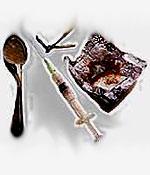 |
| Common paraphernalia
associated with heroin use include spoons, cotton balls,
needles or "rigs", foil, straws, razor blades,
matches or candles and tourniquets. |
Tolerance
What is meant by tolerance
is that the more a person uses a drug the more the person
has to take to experience the high. Heroin has a high rate
of tolerance, which makes the drug that much more addictive
and dangerous.
Addiction
Once a physical dependence occurs the user becomes addicted.
As more low-priced, high-quality street heroin becomes more
available, this can happen within the first few uses of the
drug.
Withdrawal
One of the most troubling aspects of heroin addiction
is the withdrawal period. Among users this is called “dope
sickness”. With long-term users this may be a daily exercise
in desperation. Withdrawal may occur as soon as two hours
after the last dose and symptoms include drug craving, restlessness,
insomnia, cramping, vomiting and diarrhea, cold flashes and
kicking movements (hence the term “kicking dope”).
These symptoms occur most visibly between 48 and 72 hours
after last use and may continue up to a week or more. Among
long-term dependent users withdrawal may require hospitalization
as it is occasionally fatal although less so than barbiturates
and alcohol.
|
|
|