Best Device for Streaming Sports in 2026
The best device for streaming sports is not the most expensive one, it is the one whose app is maintained properly and whose network connection is stable for ninety minutes. Two viewers on the same subscription can watch the same match with very different results, and the variable is almost always the box under the television rather than the service.
Four categories cover the market: the app built into the television, a plug-in streaming stick, a set-top box, and a games console. Each has a characteristic failure.
Best device for streaming sports: the four categories
A television app is the most convenient and the least reliable. Manufacturers support an app for a few years and then stop, which is why a five-year-old television can run a current subscription poorly or not at all while the panel itself is still perfectly good.
A streaming stick solves that by separating the software from the screen, at the cost of a slower processor than a dedicated box. Set-top boxes carry the fastest hardware and the best app support, and consoles sit in between, with a limited catalogue because the platform holders treat streaming as a secondary feature.
Streaming device for live sports: what to compare
The specification that matters for football is boring: wired network support, a processor that handles a high bitrate 2160p feed without dropping frames, and an app that is updated regularly by its developer. Memory matters more than people expect, because a device that has to swap the app in and out of storage will stutter at the moment of a goal.
Remote quality is the underrated one. A remote with a slow input path makes search and channel switching painful on every matchday, and a device that supports a phone as a remote usually solves it for free.
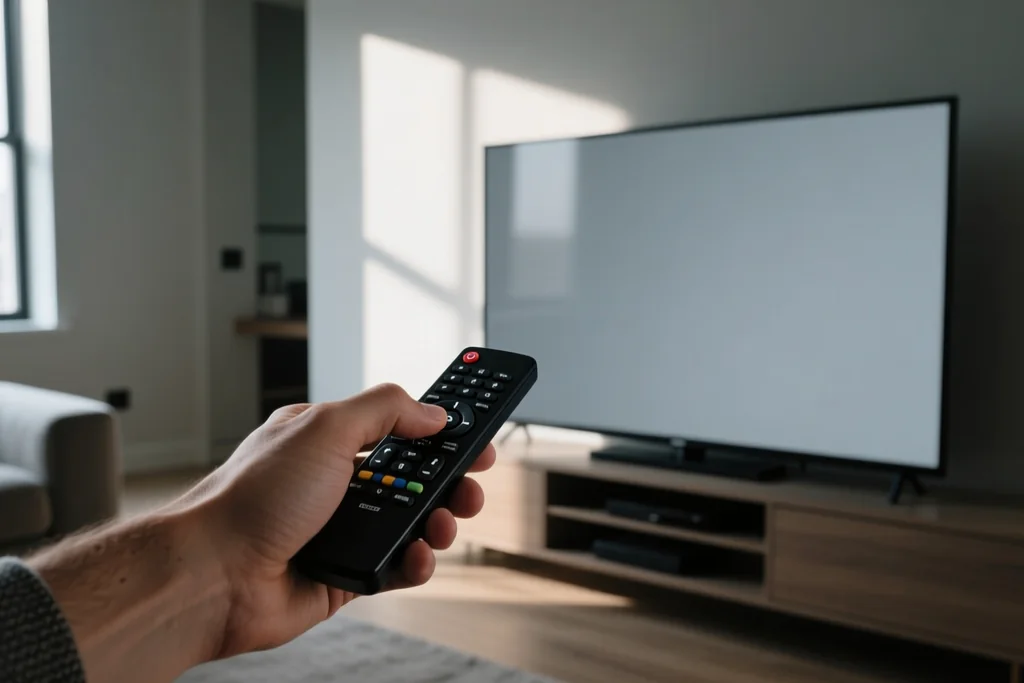
Set top box, games console and wireless speed
A set top box remains the most reliable option under a television, with a faster chip and a wired port on most models. It costs more than a stick, and it is the only category that rarely produces a mid-match stutter on a high bitrate feed.
A games console is the cheapest route for a household that already owns one, and the compromise is the app catalogue: several streaming services ship a reduced version of their app on console platforms, which sometimes omits the multi-view feature that football viewers use.
Wireless speed decides the ceiling for every device in the chain. A box connected on the older band will underperform a cheaper stick connected by cable, so measuring the throughput at the device itself is the only useful test.
The four categories compared
| Type | Strength | Weakness |
|---|---|---|
| Television app | No extra hardware, one remote | Support ends with the model year |
| Streaming stick | Cheap, portable, wide app range | Slower chip, no wired port on some models |
| Set-top box | Fast, wired, well maintained | Highest cost, more cables |
| Games console | Already owned by many households | Restricted app catalogue, higher power draw |
Refresh rate, upscaling and the panel question
The device negotiates with the television, and that negotiation sets the ceiling. A panel that cannot accept a sixty-frame-per-second signal will not display one, regardless of what the app is willing to send, and a device connected through an old cable may be forced down to a lower resolution before the picture ever reaches the screen.
- Check the maximum refresh rate the panel accepts before blaming the app.
- Use the cable supplied with the device, or one rated for the bandwidth required.
- Prefer a device with a wired network port where the router allows it.
- Install only the apps you use; memory pressure causes mid-match stutter.
- Restart the device before a big match rather than during it.
What to do if the television is the limit
An older smart television can be brought back into service by a stick or a box, which is almost always cheaper than replacing the panel. The opposite case also exists: a good panel with a weak processor is worth keeping and pairing with a fast device.
Two measurements settle the choice. Confirm the panel's resolution and refresh rate, then confirm the app is available on the device being considered. Beyond that, the 4K guide explains what a higher bitrate demands from the hardware, the buffering checklist covers the network side, and the delay piece explains why a low latency mode depends on the chip in the box.
Matching the device to the sport
Sport rewards different things from film. Motion is constant, so refresh rate and motion handling matter more than peak brightness, and a panel that looks superb on a drama can show smearing on a long pass. A television with a genuine high refresh mode is worth more here than one with a higher resolution.
The streaming stick and the set-top box do different jobs. A stick is cheap, portable and adequate for a second screen; a box has a faster processor and more memory, which shows up in how quickly an app opens and how rarely it stutters during a busy match night.
A games console is a capable player that many households already own, though its media apps are sometimes updated later than the dedicated devices. A smart television app is the laziest option and the one most likely to be dropped by a provider, which turns a built-in app into a dead row on the home screen.
Wireless speed is the number that decides the experience, and it is measured at the device rather than at the router. A stick behind a wall-mounted television can lose most of its throughput to the panel itself, which is why a short extension cable often fixes a problem that looks like a network fault.